
Non-chemical cooling tower treatment is an investment that pays for itself; chemical dosing is a cost that never stops. For hospitals, hotels, office towers and factories worldwide, that difference decides the true cost of running a cooling system with proper maintenance over 15 years or more.
This article compares the two approaches on cost, return on investment (ROI), internal rate of return (IRR), energy, downtime, equipment life and risk to people and the environment, so facility managers and finance teams can judge them on the same basis.
How chemical treatment works, and what it really costs
Conventional treatment doses the cooling water continuously with scale inhibitors, corrosion inhibitors and biocides such as chlorine or bromine compounds. The chemicals slow scale and bacteria down, but they do not remove what is already there, and they must be bought, stored, dosed and tested every month for the life of the system.
The invoice for chemicals is only the visible part. The full cost usually includes:
- Chemical purchases, every month, for as long as the tower runs
- Dosing equipment, testing and service contracts
- Extra bleed-off water to keep dissolved solids in range, plus the water to replace it
- Mechanical or acid cleaning of chillers, condensers and tower fill when scale still builds up
- Shutdowns while that cleaning is done
- Repairs and early replacement of tubes, pumps and pipes damaged by corrosion
- Handling, storage and discharge of hazardous substances
Because every one of these is a recurring expense, chemical treatment never produces a return. Spending more on it only keeps the problem under control; it never pays the money back.
How non-chemical, chemical-free treatment works
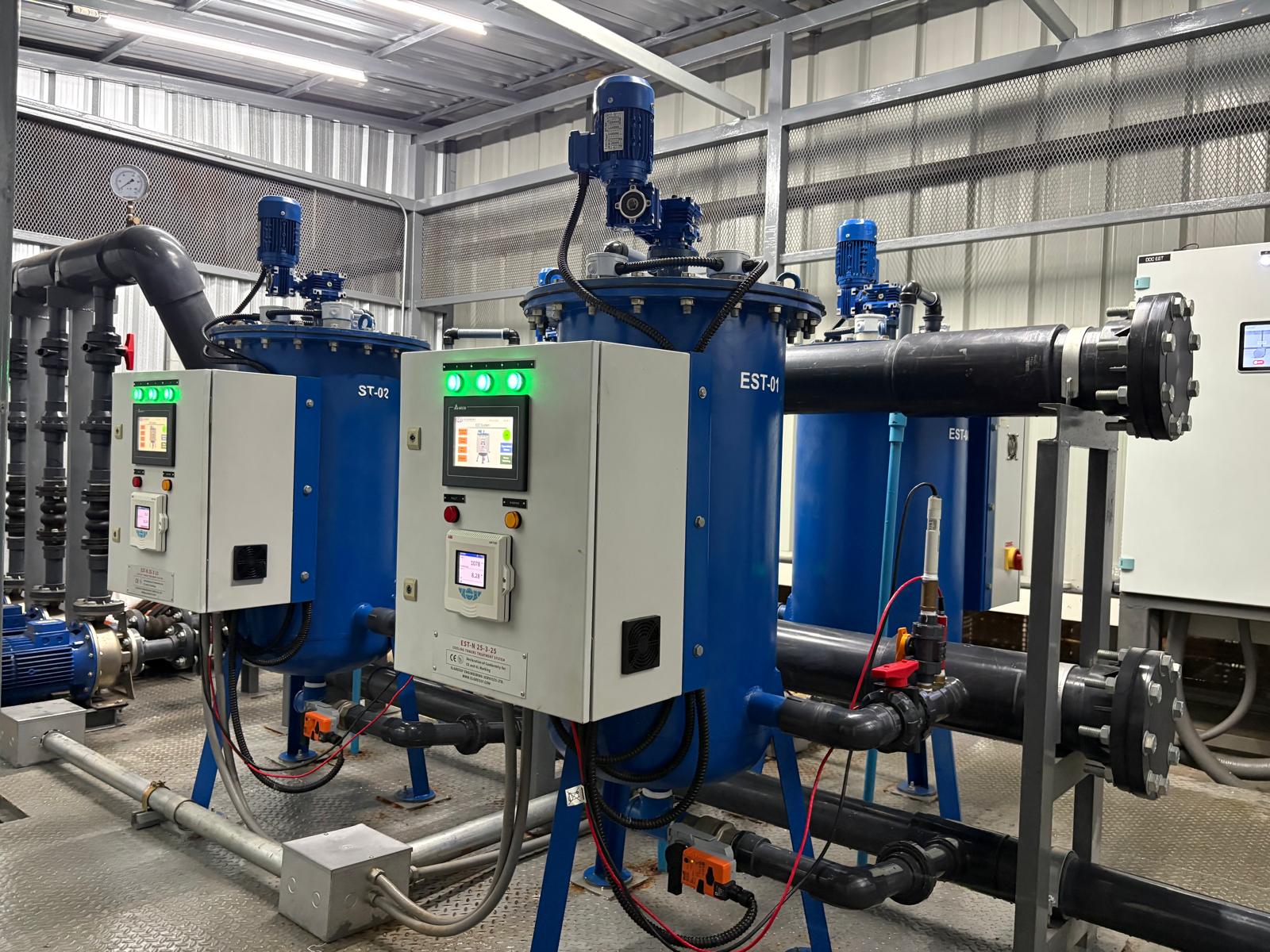
Elgressy EST (Electrochemical Scale Treatment) uses electricity instead of chemicals to control scale, bacteria and corrosion. A reaction chamber (tank) with electrodes is connected side-stream to the cooling tower, so it installs without any intervention in the existing system.
Inside the chamber (tank), three things happen at once:
- Scale removal: dissolved minerals such as calcium carbonate are drawn out of the water and deposited in the reaction chamber instead of on chiller tubes and tower fill. The collected scale is cleared out automatically.
- Disinfection: the electrochemical process generates oxidants from the water itself, which control bacteria, algae and biofilm, including Legionella.
- Corrosion control: with scale and biofilm removed and no aggressive chemicals added, the water becomes far less corrosive to metal surfaces.
The system is modular, from about 200 TR to 20,000 TR and beyond, and can be monitored remotely through SCADA.
Side-by-side comparison
| Factor | Chemical treatment | Non-chemical EST |
|---|---|---|
| Type of spending | Ongoing operating cost, every month | One-time investment, then low running cost |
| ROI and IRR | None: the money never comes back | Measurable ROI, IRR and payback period |
| Existing scale | Not removed | Removed and collected in the reaction chamber |
| Chiller energy use | Rises as scale and biofilm build up | Kept low by clean heat-transfer surfaces |
| Downtime for cleaning | Regular shutdowns for mechanical or acid cleaning | Little or none |
| Corrosion | Chemicals add to corrosion risk | Non-corrosive water, longer equipment life |
| Water use | More bleed-off needed | Less bleed-off, water savings |
| Legionella control | Depends on correct dosing | Continuous, automatic |
| Hazardous substances on site | Yes: storage, handling, PPE | None |
| Discharge to environment | Chemical residues in blowdown | No treatment chemicals in discharge |
| Supports LEED and ESG goals | Weakly | Strongly |
The ROI and IRR case: why chemicals never pay back
The right financial question is not “what does each option cost?” but “what is the return on switching from chemicals to EST?” The EST purchase is the investment; everything the site stops paying for is the yearly cash return.
The annual saving is the sum of:
- Chemical purchases, dosing and testing no longer needed
- Electricity saved by chillers running with clean tubes
- Gas or fuel saved where heat exchangers and boilers stay scale-free
- Water saved through lower bleed-off (re-usable for irrigation)
- Cleaning, repairs and spare parts avoided
- Production or service hours no longer lost to shutdowns
- Replacements of corroded equipment pushed years later
- CO2 friendly
Illustrative example (round numbers, not a quote): a 4,000 TR cooling tower would require 3 x EST-N 25-3-25 systems costing THB 3,000,000 (not installed) that saves THB 1,200,000 a year and pays back in 2.5 years. Over a 15-year life, that is an IRR of about 40% and a net present value of about THB 7.3 million at an 8% discount rate. Continuing with chemicals over the same 15 years produces no return at all.
We build this calculation example with your own bills, maintenance records and operating hours, using conservative assumptions, so the result stands up to review by your finance team.
Energy, downtime, corrosion and lifecycle savings
The biggest savings from non-chemical treatment usually come from energy, not from the chemicals themselves.
- Energy (electricity and gas): scale and biofilm act as insulation on chiller and heat-exchanger tubes. Even a thin layer forces compressors to work harder and raises the approach temperature. Keeping surfaces clean keeps kW per ton of refrigeration low, and the same applies to gas-fired heat exchangers and boilers.
- Water savings: with EST the cycles of concentration (COC) can be increased, so less water is bled off and replaced.
- No downtime: because scale is removed continuously, the regular shutdowns for mechanical or acid cleaning are no longer needed. For hospitals, data centers and 24-hour plants, those avoided hours are often worth more than the treatment itself.
- No corrosion, fewer replacements: treatment chemicals and under-deposit corrosion shorten the life of tubes, pumps, pipes, fillers and tower basins. Without them, equipment lasts longer and replacement budgets can be pushed years into the future.
- Long life cycle: an EST system is designed for long service with low maintenance, so the savings repeat year after year. The longer the evaluation period, the stronger the case becomes, which is why the calculation should run over the system’s full life, not just 3 to 5 years but 10 to 20 years with proper and frequent maintenance.
Health, safety and environmental risks
Chemical-free treatment removes a whole category of risk from the site.
- Worker safety: biocides and inhibitors are hazardous to store, handle and dose. Spills and exposure require training, PPE and emergency procedures.
- Legionella: chemical programs depend on correct dosing every day. An under-dosed or neglected tower can become a breeding ground for Legionella, a serious risk for hospitals, hotels and occupied buildings. EST disinfects continuously and automatically.
- Environment and CO2: blowdown water from chemically treated towers carries treatment residues into drains and waterways. Non-chemical treatment discharges no treatment chemicals and uses less water. The drain water is fully chemical free and re-usable for irrigation or other uses.
- Compliance and reputation: fewer hazardous substances means simpler permits and audits, and stronger results for LEED certification and ESG reporting.
Real results from our installations
Water Treatment Asia has installed Elgressy systems across Thailand and the Philippines since 2017, including the United Nations building in Bangkok, Olympia Thai Tower, Isuzu, Bridgestone, SCG Kraft, AB Food, Mitsubishi, Denso, Samyan, Aman Nai Lert, TYK, Silom, Unilever, Eagle Cement, and thousands more worldwide.
- More than 50 kg of scale removed in 6 months: at one cooling system, the EST reaction tanks collected over 50 kg of scale in six months; scale that would otherwise have coated chiller tubes and tower fill.
- Visible scale removal within 5 days: a client-installed scale filter showed the volume of scale EST took out of a cooling tower in just five days.
- Lower approach temperature and energy cost after one year: sites have tracked chiller approach temperature and energy cost a year after installation to confirm the savings. Often clients can run with fewer cooling towers and fewer chillers.
See our installations and read client reference letters.
Frequently asked questions
Is non-chemical cooling tower treatment as effective as chemicals? Yes. EST controls scale, bacteria and corrosion at the same time, and it removes existing scale, which chemical inhibitors do not.
Does chemical-free treatment control Legionella? Yes. The electrochemical process generates oxidants continuously from the water itself, so disinfection does not depend on manual dosing.
How long is the payback period? It depends on the local situation, the size of the system, water and energy prices and current chemical spend. We calculate the payback, ROI and IRR for your site from your own operating data; in general it is 1 to 3 years.
Can EST be added to an existing cooling tower? Yes. It connects side-stream, so installation needs no changes to the existing system and little or no downtime.
Which buildings and plants use it? Hospitals, hotels, office towers, data centers and factories, from about 200 TR to 20,000 TR and above.
Get your free ROI assessment
Click here to open our water questionnaire, complete all required data and send us your current make-up and cooling tower water parameters, chemical, energy, water and maintenance costs, and we will calculate the payback, ROI and IRR of switching to non-chemical treatment for your site. Contact Water Treatment Asia for a free demonstration.
We are standing by and look forward to hearing from you.





Leave A Comment