

Is Chemical-Free Cooling Tower Water Treatment a Utopia? No, It Is Here Now
For decades, cooling-tower water treatment has meant one thing: a steady supply of chemicals. Anti-scalants, corrosion inhibitors, biocides and acid are delivered, stored, dosed and eventually discharged, month after month. So when someone proposes running a cooling tower without chemicals, many engineers react with healthy scepticism: is this a real solution, or a utopia?
Our answer is clear: chemical-free cooling tower water treatment is not a utopia. It is here now. Proven physical and electrochemical technologies, such as electrolysis, already protect cooling systems in hospitals, hotels, data centers and factories. At the same time, the term “chemical-free” is often oversold. This article explains what really works, where the limits are, and how to evaluate a system with confidence.
Why Chemicals Became the Default
A cooling tower cools by evaporation. As water evaporates, the dissolved minerals stay behind and concentrate: evaporation leads to saturation. That creates three constant problems:
- Scale: calcium carbonate and other hardness minerals deposit on condenser tubes and heat exchangers, reducing heat transfer and raising energy use.
- Corrosion: pipes, tubes and tower components lose metal, especially under deposits.
- Biofouling: warm, aerated water is an ideal home for bacteria, algae, biofilm and Legionella.
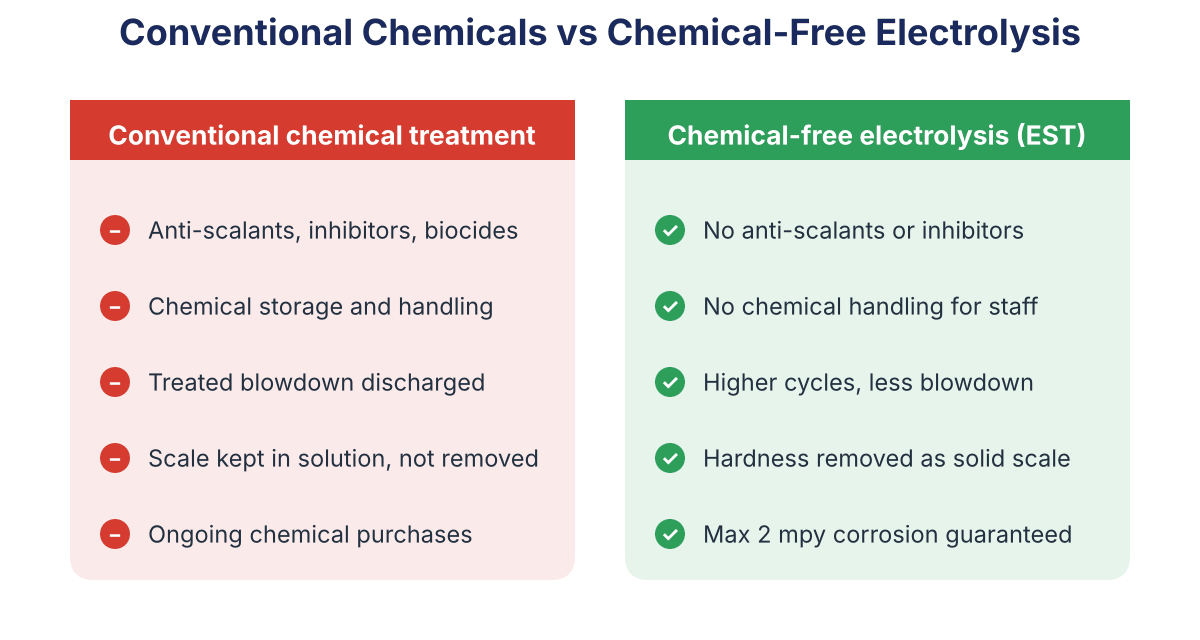
Chemical programs control these problems by keeping minerals in solution, filming metal surfaces and killing microorganisms. They work to a degree, but at a recurring cost: chemical purchases, handling and storage risks for staff, discharge of treated blowdown, and in many cases low pH (corrosive) conditions or aggressive oxidizers that shorten equipment life.
What “Chemical-Free” Really Means
Chemical-free treatment does not ignore water chemistry. It controls it with physics and electrochemistry instead of added products. The main approaches are:
- Electrolysis with Elgressy EST: a side stream of cooling water passes through reactors where a DC current raises the pH at the cathode. Hardness precipitates there as solid scale and is removed from the system, while oxidizing species formed at the anode help control biofilm.
- Side-stream filtration: removes suspended solids, dirt and debris that feed bacteria and cause under-deposit corrosion.
- UV disinfection: inactivates microorganisms in water passing through the unit, as a supporting measure.
- Magnetic and electronic “conditioners”: widely marketed, but with inconsistent independent evidence. This is where much of the overselling comes from.
The key difference is measurable removal. Electrolysis physically takes hardness out of the water: you can see and weigh the scale collected in the reactors. Measure the calcium in the cooling-tower water entering EST and in the treated water leaving it: the drop in calcium (delta calcium) is direct evidence that hardness has been removed. Devices that only claim to “change the crystal structure” of scale cannot show the same evidence.
Where Chemical-Free Treatment Works Today
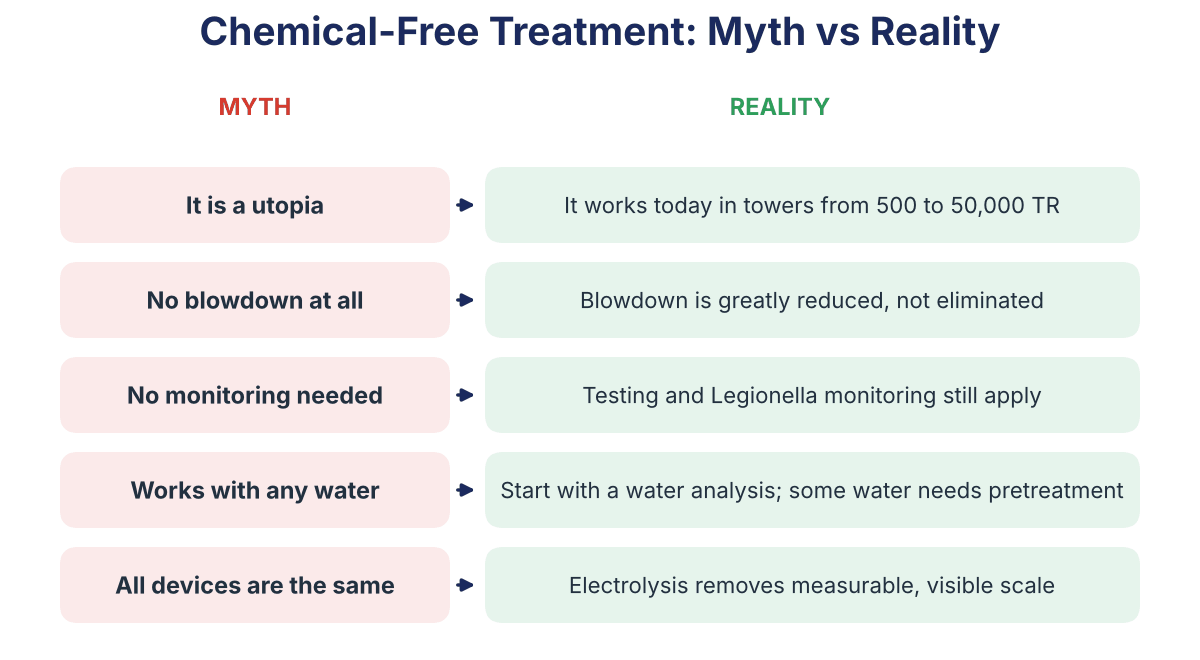
Electrolysis-based treatment is proven in open recirculating cooling towers serving chillers and process cooling worldwide, typically from around 500 TR up to 50,000 TR. Typical users include:
- Hospitals, where staff safety and Legionella control are critical.
- Hotels and commercial buildings aiming for lower operating costs and green building credits such as LEED.
- Data centers that need reliable, continuous cooling.
- Factories and industrial plants with large cooling loads and high chemical spend.
In these applications, plants run at higher cycles of concentration, use less make-up water, keep condenser tubes clean and stop buying anti-scalants and corrosion inhibitors. With Elgressy EST, Water Treatment Asia guarantees a maximum mild-steel corrosion rate of 2 mpy.
Where the Claims Get Oversold
Being honest about the limits is what makes chemical-free treatment credible. Be careful with any supplier who claims:
- “No blowdown at all”: blowdown is greatly reduced, but some bleed is still needed to control dissolved salts such as chlorides and sulphates.
- “No monitoring needed”: every cooling tower still needs a water management plan, regular testing and Legionella monitoring, whatever the treatment.
- “Works with any water”: very high silica, heavy contamination or process leaks may need pretreatment or additional measures. A water analysis should always come first.
- “Suitable for everything”: large municipal drinking-water networks are a different application and still rely on a disinfectant residual by regulation.
“Chemical-free” is therefore not a magic box. It is a proven engineering solution that must be correctly sized, installed and maintained.
How to Evaluate a Chemical-Free System
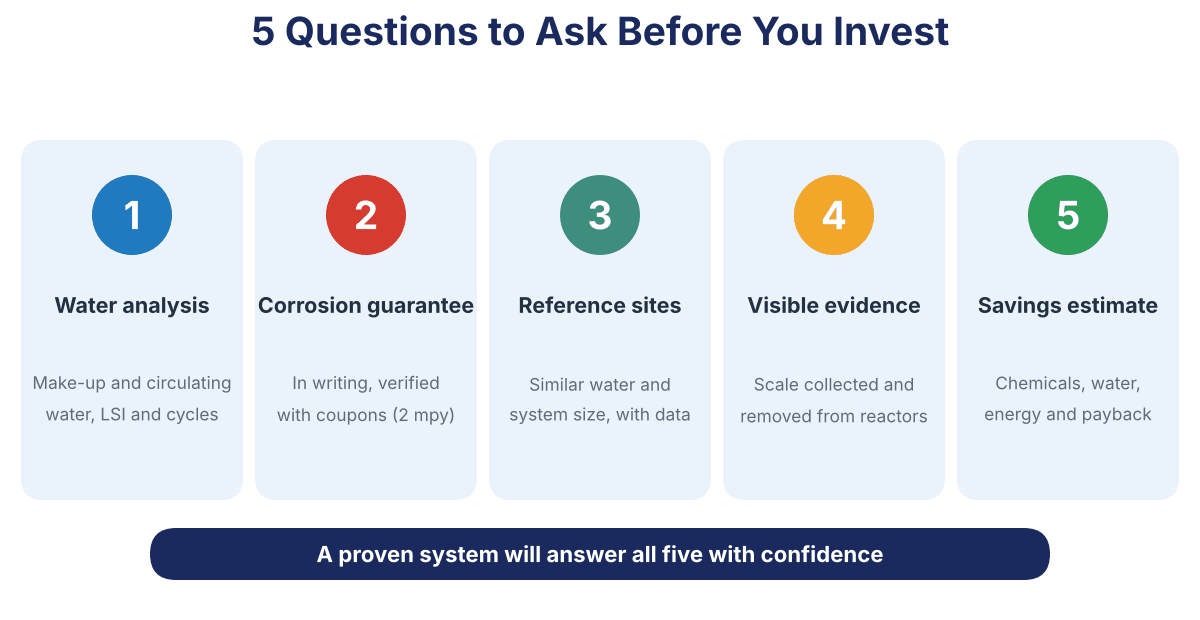
Before you invest, ask the supplier for:
- A water analysis of your make-up and circulating water, with an LSI and cycles-of-concentration assessment.
- A written corrosion guarantee, verified with corrosion coupons (for example, maximum 2 mpy for mild steel).
- Reference sites with similar water quality and system size, and the operating data to back them up.
- Visible evidence of how the system works, such as scale collected and removed from the reactors, and the measured drop in calcium across the system.
- A clear savings estimate covering chemicals, water, energy and maintenance, with a realistic payback period.
Conclusion: The Future Is Now
Chemical-free cooling tower water treatment is not a utopia. Electrolysis already removes hardness, controls biofouling and keeps corrosion low in cooling systems across Southeast Asia, while cutting chemical, water and energy costs. It is not a cure-all, and not every product sold as “chemical-free” delivers. But with the right technology, a proper water analysis and a measurable guarantee, going chemical-free is a practical decision you can make today.
Related Reading
- Elgressy EST: Chemical-Free Scale, Corrosion and Biofouling Control for Cooling Towers
- Legionella in Cooling Towers: Risks, Warning Signs and How to Prevent It
- Calcium Carbonate (CaCO3) Scale in Heat Exchangers
- LEED Certification Explained: Levels, Credits and How Cooling-Water Treatment Helps
Contact Us Right Away
Water Treatment Asia has been the exclusive distributor of Elgressy EST in Southeast Asia since 2010. Whether you want to cut chemical costs, save water and energy, or protect your chillers from scale and corrosion, our team is ready to help.
Contact us right away for:
- A free water analysis of your cooling tower
- A free savings estimate for chemicals, water, energy and maintenance
- A visit to one of our reference sites to see EST in operation
- A tailored EST proposal with our 2 mpy corrosion guarantee





Leave A Comment