
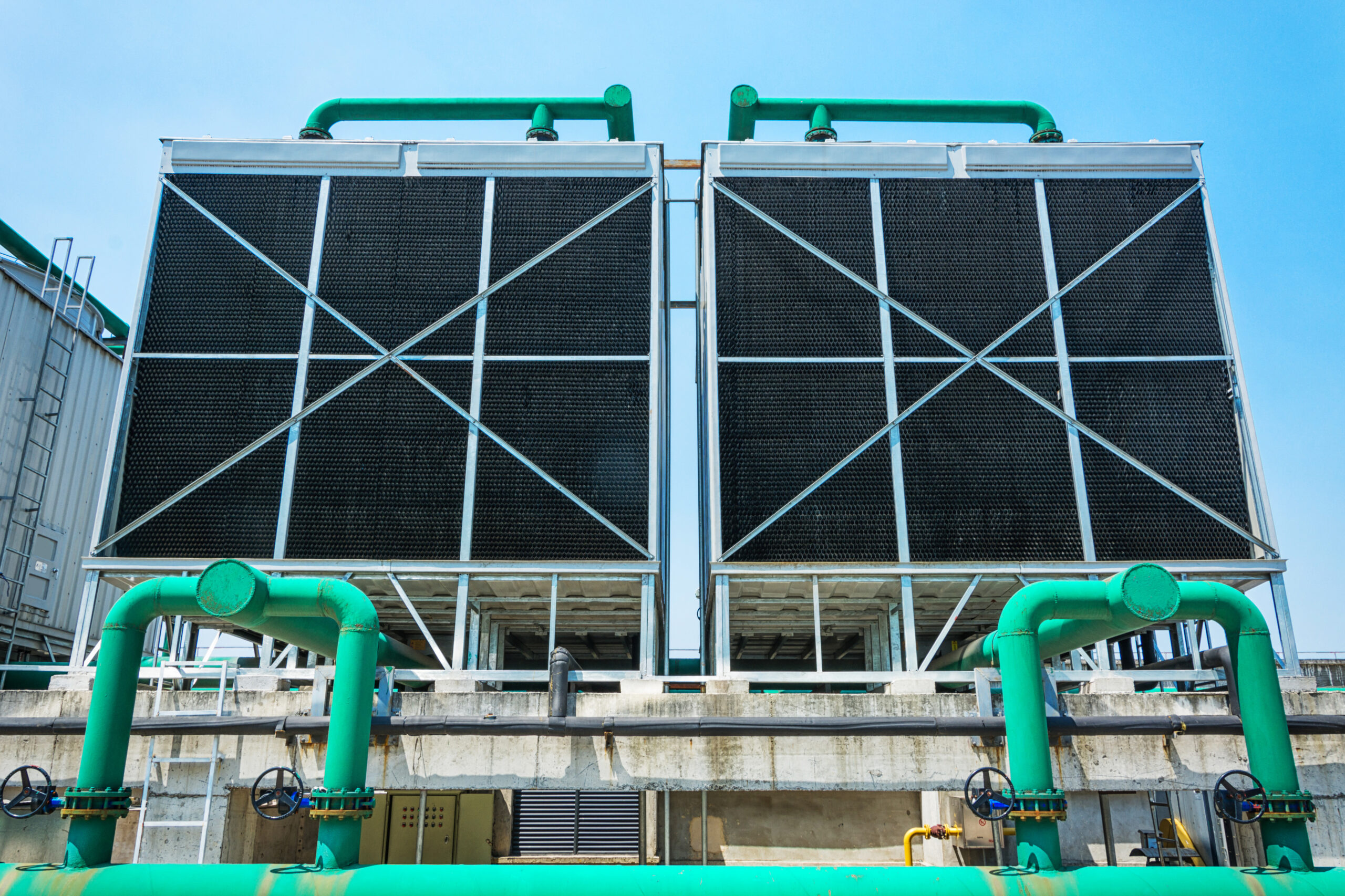
How Can You Save Water? Cooling Tower Water Savings with Elgressy Electrolysis Technology
Cooling towers are often the biggest water user in a building or plant. Every day they evaporate water to remove heat, and they drain away more water to keep dissolved salts under control. With water and wastewater prices rising and droughts becoming more frequent, cutting that consumption is both a cost saving and a responsibility.
This article explains where cooling tower water goes and how large cooling tower water savings can be. It also shows how the chemical-free Elgressy EST (Electrolysis Scale Treatment) and EEC (Electro-Coagulation) systems help plants use less water and reuse more of it.
Key points for management
- Blowdown is the water you can save. Evaporation follows the law of saturation and is fixed by the cooling load. Blowdown, however, depends mostly on how the water is treated.
- Higher cycles mean less water. According to the U.S. Department of Energy, increasing cycles of concentration from 3 to 6 reduces make-up water by 20% and blowdown by 50%.
- Elgressy EST removes hardness in its reactors, so cooling towers can often run at higher cycles without scaling.
- Chemical-free drain water can be reused for irrigation, which brings the blowdown that is actually lost close to zero.
- Elgressy EEC treats wastewater for reuse, closing the loop further.
Where does cooling tower water go?
Every cooling tower follows a simple water balance: make-up water = evaporation + blowdown + drift.
- Evaporation is how the tower removes heat, and it follows the law of saturation. The air leaving the tower is saturated with water vapour. So the amount that evaporates is set by the heat load and the weather, not by the water treatment. As a common rule of thumb, about 1% of the circulating water evaporates for every 5.5 °C of cooling. You cannot avoid it without losing cooling.
- Blowdown (also called bleed-off or drain) removes water that has become too concentrated with dissolved salts, before those salts form scale. Fresh make-up water replaces it.
- Drift is the small amount of water carried away as mist. In a well-maintained tower it is minor.

The key number is the cycles of concentration: how many times the dissolved salts in the tower water are concentrated compared with the make-up water. The higher the cycles, the less blowdown is needed. The U.S. Department of Energy notes that many systems run at only two to four cycles, while six or more may be possible.
Why chemical treatment limits your water savings
With chemical treatment, the tower water carries all its hardness, silica and other salts until they are drained away. Run the cycles too high and scale forms on condenser tubes and fill, no matter how much inhibitor is dosed. So most chemical programmes keep the cycles low and accept a high blowdown rate.
That drained water also contains the treatment chemicals, which limits how it can be reused and adds to the plant’s wastewater load.
How Elgressy EST saves water
Elgressy EST treats cooling tower water by electrolysis, with no chemicals. Instead of keeping hardness dissolved, it removes it.
- Hardness leaves the system as scale in the reactor. More than 30% of the calcium is precipitated inside the EST reaction tanks before it can reach the chillers or fill. At one client site, more than 50 kg of scale was collected in six months.
- Higher cycles of concentration. Because hardness is removed continuously, towers can often run at higher cycles without scaling. That means less blowdown and less make-up water. At Taj Holiday Village in Goa, India, an IFC TechEmerge pilot, the cooling tower went from 3 cycles with chemicals to 7 cycles with EST.
- Close to zero blowdown with irrigation reuse. The water that is drained contains no treatment chemicals, so it can be reused for irrigation instead of being discharged. With irrigation reuse, the blowdown that is actually lost comes close to zero. Almost all the water the tower takes in is then used for cooling.
- Clean fill and tubes, less wasted water. No acid cleanings or flushing after chemical overdosing, and SCADA remote monitoring to keep the system on target.

Cooling tower water savings depend on the make-up water quality and the cycles you run today. In our proposals for plants in Thailand, we typically estimate 30% to 60% water savings, calculated from each site’s own data.
How Elgressy EEC helps you reuse water
Elgressy EEC treats wastewater by electro-coagulation, without coagulant chemicals or polymers. It turns water that would be discharged into water that can be used again.
- Treated water for reuse. Water treated by EEC is often reusable for irrigation and some processes.
- Pre-treatment for reverse osmosis. EEC removes silica, heavy metals, oils and suspended solids before R/O, helping water recycling systems work reliably. At Eagle Cement in the Philippines, EEC reduced silica from 180 ppm to 8 ppm.
- Cleaner effluent. Because no reagents are added, EEC reduces sodium, sulfates and chlorides in the effluent compared with chemical treatment.
- Modular from 1 to 100 m³/h and more, so a reuse system can start small and grow.
A simple example of cooling tower water savings
The figures below are an illustration only, for a 1,000 TR cooling tower running 24 hours a day with a 5.5 °C cooling range. Replace them with your own data.
| 3 cycles of concentration | 6 cycles of concentration | |
|---|---|---|
| Evaporation | 6.8 m³/h | 6.8 m³/h |
| Blowdown | 3.4 m³/h | 1.4 m³/h |
| Make-up water | 10.2 m³/h | 8.2 m³/h |
| Water saved per year | – | about 17,900 m³ |
| Saving at THB 32.50 per m³ | – | about THB 580,000 a year |
That is a 20% cut in make-up water and, in this example, a 60% cut in blowdown. Wastewater charges and the chemicals no longer bought come on top.
Then reuse the remaining 1.4 m³/h of chemical-free drain water for irrigation. The blowdown that is lost drops close to zero. About 12,000 m³ a year of irrigation water no longer has to come from somewhere else. The only water the tower then really consumes is what evaporates to do the cooling.
Chemical treatment vs Elgressy EST and EEC at a glance
| Chemical treatment | Elgressy EST / EEC | |
|---|---|---|
| Hardness and salts | Kept dissolved until drained | Hardness removed as scale in the reactor (EST) |
| Cycles of concentration | Usually kept low to avoid scale | Often higher, so less blowdown |
| Drain water | Contains treatment chemicals | Chemical-free; irrigation reuse brings blowdown close to zero |
| Wastewater reuse | Chemical coagulants add salts and sludge | EEC prepares water for reuse and R/O |
| Monitoring | Manual testing and dosing | Automatic, with optional SCADA |
Five questions to ask about your water use
- How much make-up water do your cooling towers use per month, and do you have meters on make-up and blowdown?
- At how many cycles of concentration do your towers run today?
- What do you pay per m³ for water, and for wastewater discharge?
- Where does your blowdown water go, and could it be reused?
- Do you have wastewater that could be treated and reused instead of discharged?
Frequently asked questions
How does electrolysis save water in a cooling tower? Elgressy EST removes hardness from the circulating water by precipitating it as scale inside its reaction tanks. With less hardness in the water, the tower can often run at higher cycles of concentration. Less water is drained, so less make-up water is needed.
How large are cooling tower water savings with EST? It depends on your make-up water quality and current cycles. The U.S. Department of Energy notes that going from 3 to 6 cycles cuts make-up water by 20%. In our proposals for Thai plants we typically estimate 30% to 60% water savings, based on each site’s data.
Can the drain water be reused? Yes. Because EST uses no chemicals, the drain water can be used for irrigation. With irrigation reuse, the blowdown that is lost comes close to zero.
Can treatment reduce evaporation? No. Evaporation follows the law of saturation and is set by the cooling load and the weather. What treatment can reduce is blowdown, and with EST and irrigation reuse that loss comes close to zero.
Does EST need a shutdown to install? No. EST connects side-stream, so it can usually be installed with little or no downtime.
What does EEC add? EEC treats wastewater without chemicals so it can be reused for irrigation, some processes, or as pre-treatment for reverse osmosis.
Get your free water savings and ROI assessment
Click here to open our water questionnaire and complete all required data. Send us your water parameters, water and wastewater costs, current cycles of concentration, and chemical, energy and maintenance costs. We will calculate your cooling tower water savings, payback, ROI and IRR of switching to Elgressy EST or EEC. Contact Water Treatment Asia for a free demonstration.
Read more: Cooling tower downtime cost, Extend chiller and cooling tower life, Non-chemical vs chemical cooling tower treatment, EST overview and EEC electro-coagulation.
Sources
- U.S. Department of Energy, Federal Energy Management Program, Best Management Practice #10: Cooling Tower Management
- Environmental Design Solutions (EDS), site visit report, Taj Holiday Village Goa, IFC TechEmerge Sustainable Cooling Innovation pilot, July 2022
- Elgressy EST and EEC client results and proposal estimates as reported by Water Treatment Asia


Leave A Comment