
Is Downtime Costly? What Cooling Tower and Wastewater Shutdowns Really Cost
Yes, downtime is costly, and for most plants it is far more expensive than the water treatment itself. Every hour a cooling tower, chiller or wastewater line stands still for cleaning or repair costs lost production, labour, energy and sometimes penalties. Yet many plants still accept these shutdowns as “normal maintenance”, and few ever add up their true cooling tower downtime cost.
This article explains what downtime really costs, where it comes from in cooling water and wastewater systems, and how the chemical-free Elgressy EST (Electrolysis Scale Treatment) and EEC (Electro-Coagulation) systems help plants avoid it.
What downtime costs industry today
Siemens’ report The True Cost of Downtime 2024 puts numbers on the problem:
- Almost US$1.4 trillion a year is lost to unplanned downtime by the world’s 500 largest companies, about 11% of their revenue.
- A typical large plant still loses 27 hours a month to unplanned downtime.
- One hour of downtime costs about US$2.3 million in a large automotive plant and about US$36,000 even in fast-moving consumer goods, the lowest-cost sector in the study.
- In heavy industry, an hour of downtime now costs four times as much as in 2019.
Your plant’s figure will be different, but the lesson is the same: when production stops, the cost per hour is usually much higher than the cost of preventing the stop.
Planned shutdowns are downtime too
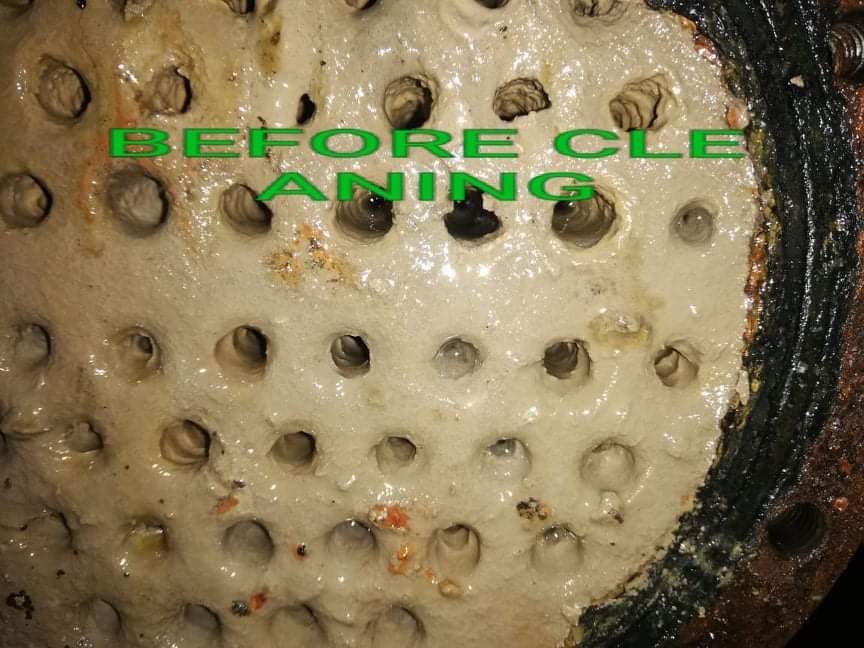
Not all downtime is a breakdown. Under a chemical treatment programme, chillers, condensers, heat exchangers and cooling tower fill slowly collect scale, corrosion products and biofilm. Sooner or later they need mechanical or acid cleaning, and every cleaning means a shutdown.

Because these stops are planned, they rarely appear in the treatment budget. But they cost the same lost hours, plus:
- Cleaning contractors, acid and labour for every cleaning cycle
- Replacement parts when corrosion eats through tubes, pipes, valves and pumps
- Emergency stops when scale or a Legionella result forces the system offline unexpectedly
- Chemical handling and safety work, which never stops while the tower runs
The hidden cost before the shutdown: lost efficiency
Scale does not only cause shutdowns. Long before cleaning day, it is already costing money in energy, because scale insulates heat transfer surfaces.
Published heat-transfer data show how quickly this adds up. A calcium carbonate scale layer of only 0.3 mm (0.012 inch) cuts the heat transfer coefficient by about 21%, and 0.6 mm by about 34%. In practice that shows up as a rising approach temperature, and the chiller and condenser must work harder to deliver the same cooling. The same data show chiller power rising by about 4% to 9% as fouling increases, and condenser power by 5% to 14%.
So a plant on chemical treatment typically pays twice: first in higher energy use while scale builds up, then in downtime and cleaning costs to remove it.
A simple example: cooling tower downtime cost for a typical plant
The numbers below are an illustration only, using round assumptions. Replace them with your own figures.
| Cost item | Assumption | Cost per year |
|---|---|---|
| Cleaning shutdowns | 2 shutdowns of 16 hours, THB 150,000 lost contribution per hour | THB 4,800,000 |
| Cleaning contractors, acid and labour | THB 250,000 per cleaning | THB 500,000 |
| Extra chiller energy from fouling | 1,000 TR plant, 450 kW chillers, 24/7, THB 4.18/kWh, 9% penalty | THB 1,480,000 |
| Total cost of fouling and downtime | about THB 6.8 million |
That is before chemical purchases, corrosion damage, shorter equipment life or a single unplanned stop. For many plants, the cost of downtime alone is larger than the cost of a chemical-free treatment system.
How Elgressy EST reduces cooling tower downtime
Elgressy EST treats cooling tower and chiller water by electrolysis, with no chemicals. It removes the root cause of most cleaning shutdowns: scale, biofilm and corrosion on heat transfer surfaces. That is how it cuts your cooling tower downtime cost.
- Scale ends up in the reactor, not in your equipment. More than 30% of the calcium is precipitated inside the EST reaction tanks before it can form scale. At one client site, more than 50 kg of scale was collected in the four EST reaction tanks in six months, and none of it deposited in the pipes, towers, pumps, valves or chillers.
- Heat exchangers stay clean. At Tec de Monterrey, chiller approach temperatures stayed low without cleaning, where they had kept rising under the previous chemical programme.
- Less maintenance. Sites report about 40% less maintenance. Cleaning the EST reaction tanks is a routine service that does not stop the cooling system.
- Corrosion under control. EST is guaranteed to keep corrosion at a maximum of 2 mpy, protecting tubes, pipes and pumps from early replacement.
- Installed without a shutdown. EST connects side-stream, so it can be added to an existing system with little or no downtime.
- Problems seen before they stop the plant. Optional SCADA remote monitoring shows pH, conductivity and system status in real time.

How Elgressy EEC reduces wastewater downtime
Wastewater treatment stops production too: when a chemical feed runs out, when sludge handling cannot keep up, or when effluent goes out of specification. Elgressy EEC removes contaminants by electro-coagulation instead of chemical dosing.
- No chemical feed to run out. EEC needs no coagulants, polymers or other reagents, so there is no dosing system to fail.
- Significantly less sludge. Less sludge to handle and dispose of means fewer bottlenecks and lower disposal costs.
- Fully automatic, with simple service. Electrode replacement is simple and service needs are minimal.
- Modular from 1 to 100 m³/h and more, so capacity can grow without rebuilding the plant, and units can be serviced one at a time.
- Proven results. At Eagle Cement in the Philippines, EEC reduced silica from 180 ppm to 8 ppm.
Chemical treatment vs Elgressy EST and EEC at a glance
| Chemical treatment | Elgressy EST / EEC | |
|---|---|---|
| Cleaning shutdowns | Regular mechanical or acid cleaning | Scale is collected in the reactor; cleaning shutdowns are largely avoided |
| Energy | Rises as scale and biofilm build up | Heat transfer surfaces stay clean |
| Corrosion | Depends on correct dosing | Guaranteed maximum 2 mpy (EST) |
| Running cost | Chemicals every month, for ever | Electricity and routine service only |
| Wastewater sludge | Chemical coagulants add sludge | Significantly less sludge (EEC) |
| Installation | Dosing skids and chemical storage | Side-stream or modular, little or no downtime |
| Safety and environment | Chemical storage, handling and discharge | Chemical-free; drain water can often be reused for irrigation |
Five questions to ask about your own downtime
- How many hours a year are your chillers, condensers or cooling towers offline for cleaning?
- What does one hour of lost production cost your plant?
- Is your chiller approach temperature rising between cleanings?
- How much did you spend on tube, pipe or pump replacement in the last five years?
- Has your wastewater line ever stopped because of chemical supply, sludge or effluent quality?
If the answers add up to more than your water treatment budget, downtime is costing you more than treatment, and that is where the savings are.
Frequently asked questions
Is downtime really more expensive than water treatment? In most plants, yes. A single day of lost production or one major cleaning often costs more than a year of chemical-free treatment. That is why cooling tower downtime cost belongs in every treatment decision.
Does EST need a shutdown to install? No. EST connects side-stream, so it can usually be installed with little or no downtime.
Does EST remove existing scale? Yes. It gradually removes existing scale and collects it in the reaction tanks, which are cleaned as routine service.
Which wastewater can EEC treat? EEC removes heavy metals, silica, oils, suspended solids, dyes and other contaminants, for industries such as food, power, chemical, pharmaceutical, mining, dyeing and leachate treatment.
How do I know the savings for my site? We calculate them from your own bills, maintenance records and operating hours, using conservative assumptions.
Get your free downtime and ROI assessment
Click here to open our water questionnaire, complete all required data and send us your water parameters, cleaning frequency, downtime hours, and chemical, energy, water and maintenance costs. We will calculate your cooling tower downtime cost, and the payback, ROI and IRR of switching to Elgressy EST or EEC. Contact Water Treatment Asia for a free demonstration.
Read more: Less downtime: fewer shutdowns for cleaning, Non-chemical vs chemical cooling tower treatment, EST overview and EEC electro-coagulation.
Sources
- Siemens, The True Cost of Downtime 2024
- Bond Water Technologies, The Effects of Scale on Heat Transfer and Energy
- Elgressy EST and EEC client results as reported by Water Treatment Asia


Leave A Comment