How Non-Chemical Water Treatment Removes 2.2 Tonnes of Scale a Year: Elgressy EST at AB Food
Scale is the most common problem in cooling water systems. Calcium carbonate settles on condenser tubes and cooling tower fill, heat transfer drops, and the chillers use more energy to do the same work. Most plants fight it with scale-inhibitor chemicals that have to be dosed every day, for as long as the system runs.
AB Food in Thailand takes a different approach. Its cooling water runs through Elgressy EST (Electrolysis Scale Treatment) units, a non-chemical water treatment for cooling towers. This case study shows what the EST removes, where the scale goes, and what the lab found when it analysed it.

Key results
- About 6 kg of scale a day is flushed out of each EST tank.
- About 2.2 tonnes a year per EST tank: scale that never reaches the condenser or the tower fill.
- Manual cleaning only every 3 to 4 months, removing a further 3 to 7 kg from the tank walls.
- About 75% calcium carbonate in the collected scale, with almost no iron, copper or zinc.
How the EST removes scale without chemicals
Cooling water passes through the EST tank, where electrolysis makes calcium and magnesium precipitate on the tank wall instead of on the heat transfer surfaces downstream. A scraper turns on a timer and keeps the wall clear, so the unit keeps working at full capacity. The loosened scale is then flushed out automatically into a drain sieve, where it is collected and bagged.
The hardness is taken out of the water, so the water reaching the condenser and the cooling tower has less scale to deposit.
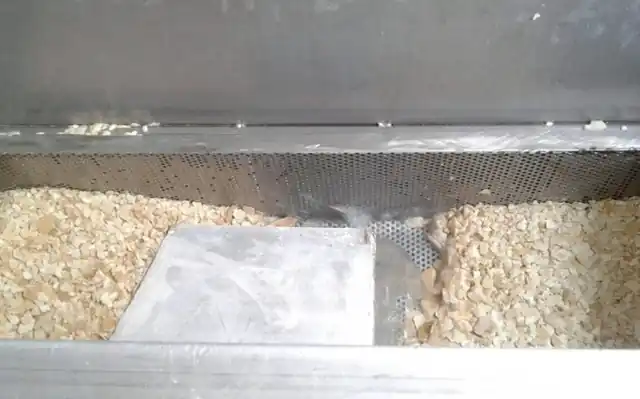
Every day: about 6 kg in the drain sieve
These photos show the scale flushed out of one EST tank. It comes out as hard, flaky chips that are easy to handle and dispose of.


Every 3 to 4 months: a short tank cleaning
Because the scraper and the automatic flush do most of the work, the tank needs a manual cleaning only every 3 to 4 months. Each cleaning removes 3 to 7 kg of residual scale from the tank walls, depending on the hardness of the make-up water.


What the lab found in the scale
In April 2024 a sample of the scale collected at AB Food was analysed by XRF. The results:
| Component | Formula | wt % |
|---|---|---|
| Calcium oxide | CaO | 42.50 |
| Magnesium oxide | MgO | 12.01 |
| Silica | SiO2 | 4.90 |
| Sodium oxide | Na2O | 2.34 |
| Potassium oxide | K2O | 0.35 |
| Strontium oxide | SrO | 0.19 |
| Iron(III) oxide | Fe2O3 | 0.09 |
| Sulfur trioxide | SO3 | 0.09 |
| Barium oxide | BaO | 0.07 |
| Aluminium oxide | Al2O3 | 0.04 |
| Chloride | Cl | 0.04 |
| Copper oxide | CuO | 0.02 |
| Zinc oxide | ZnO | 0.01 |
| Phosphorus pentoxide | P2O5 | 0.01 |
Converted to compounds, the scale is roughly 75% calcium carbonate, 17% magnesium hydroxide or carbonate and 5% silica. The oxides add up to about 63%; the rest is carbon dioxide and water bound in the carbonates, which XRF does not report.
Two things stand out:
- It is hardness scale. Calcium and magnesium dominate, which confirms the EST is taking the scale-forming minerals out of the water.
- There is no sign of corrosion. Iron (0.09%), copper (0.02%) and zinc (0.01%) are close to zero, so the deposit contains practically no corrosion products from the plant’s piping or heat exchangers.
What this means for a cooling water system
- Scale stays out of the plant. Hardness ends up in the EST tank and the drain sieve, not on condenser tubes or tower fill.
- No scale-inhibitor chemicals. Scale control comes from electrolysis, not daily dosing.
- Low maintenance. Automatic scraping and flushing, with a manual cleaning only every 3 to 4 months.
How much scale is in your cooling water?
Send us your make-up water analysis and your cooling tower capacity. ALA, the exclusive Elgressy distributor in Southeast Asia since 2010, will estimate your scale load and size an EST system for your plant. Contact Water Treatment Asia, or call 064 284 6598 (English) or 063 957 8383 (Thai).
Read more: EST overview, Non-chemical vs chemical cooling tower treatment, Cooling tower water savings and Case study Mexico.
Sources
- XRF analysis of scale collected from the EST at AB Food, April 2024
- AB Food site records and photos, Elgressy EST operation and maintenance, as reported by Water Treatment Asia


