Electroplating lines are among the hardest wastewater sources a factory can have. Every rinse carries a different mix of nickel, zinc, copper, tin, chromium, oils, surfactants and sometimes cyanide, and the usual answer is a physicochemical plant that runs on a steady supply of chemicals and produces a steady stream of sludge.
Elgressy’s distributor in Mexico recently completed a technical evaluation of the Elgressy EEC electrocoagulation system for an automotive surface-treatment plant in Guanajuato. The question was simple: can EEC bring the plant’s rinse water in line with Mexico’s discharge standard, without chemical treatment agents? This article summarises the evaluation.
The plant and its wastewater
The plant plates Zamak (zinc alloy) and copper-alloy parts for the automotive industry. Its rinse water comes from nine separate streams:
- Alkaline cleaning, acid activation and passivation rinses from the Zamak line
- Alkaline cleaning and acid activation rinses from the copper-alloy line
- Rinses from sulfamate nickel plating, tin sulfate plating and the alkaline activation step between them
- Rinses from a cyanide copper strike
All streams go to one treatment plant with a maximum flow of 2.03 m³/h, running around the clock (8,760 hours a year). Each stream has a different chemistry, with heavy metals, cyanide and COD at very different levels. The target is compliance with NOM-002, the Mexican standard for discharges to municipal sewers.
How EEC treats it
Electrocoagulation passes the water between sacrificial metal electrodes. The electrodes release metal ions that neutralise the charge on dissolved and suspended contaminants, so they bind together into flocs. The flocs are then removed by flotation and filtration. No coagulants, flocculants or pH chemicals are dosed, and each EEC unit uses about 1.25–1.5 kWh.
The proposed system
| Units | 4 in total: 1 × EEC-1 and 3 × EEC-2 |
| Cyanide copper strike rinse | Treated separately on the EEC-1 (120 L/h, three passes through the unit) |
| Combined effluent | 3 × EEC-2 for the full 2.03 m³/h |
| Electrode material | Iron |
| Electrode replacement | About every 3 months |
| Maintenance | Quarterly cleaning |
| Power use | 1.25–1.5 kWh per unit |
The evaluation results
The results below come from the Mexican distributor’s project simulation, based on the plant’s measured inlet water quality. They are expected values, not yet measurements from an installed system.

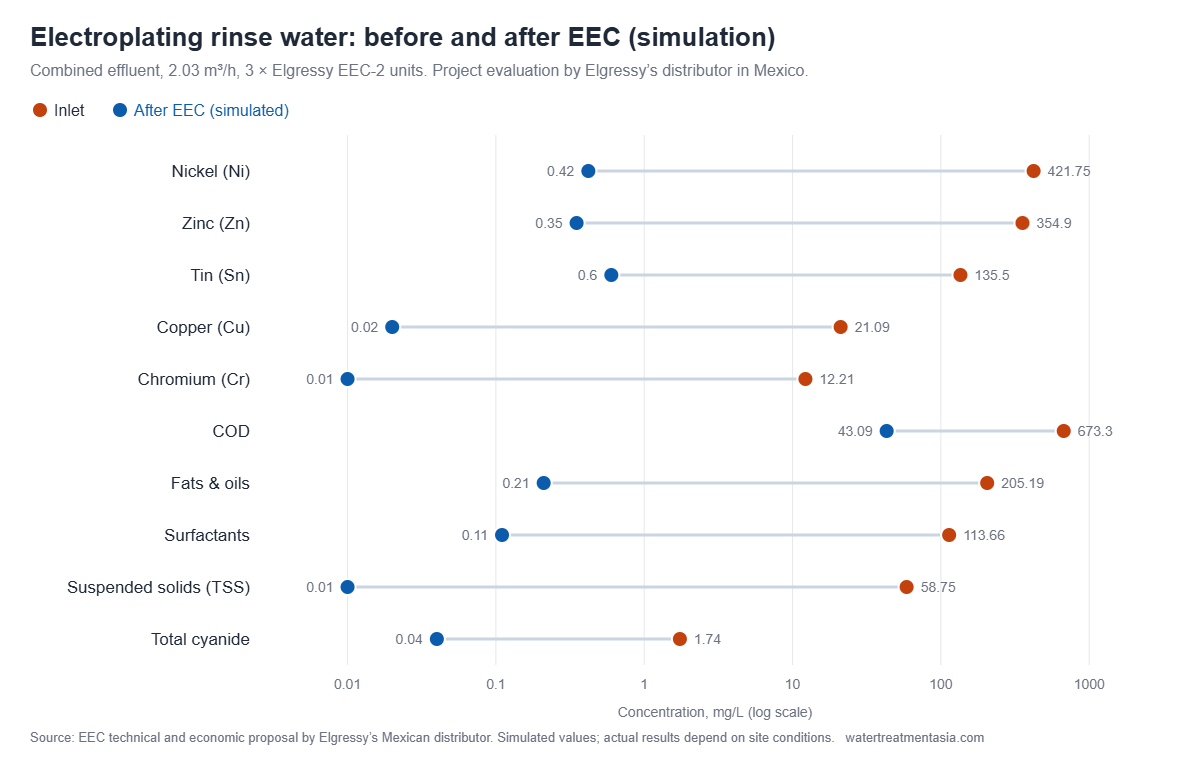
For the combined effluent, the simulation shows:
- Heavy metals: nickel from 421.75 to 0.42 mg/L, zinc from 354.90 to 0.35 mg/L, tin from 135.50 to 0.60 mg/L, copper from 21.09 to 0.02 mg/L and chromium from 12.21 to 0.01 mg/L, all removed by more than 99%.
- Oils and surfactants: fats and oils from 205.19 to 0.21 mg/L, surfactants from 113.66 to 0.11 mg/L.
- COD: from 673.30 to 43.09 mg/L (94% removal).
- Total cyanide: from 1.74 to 0.04 mg/L (98% removal).
The cyanide copper strike rinse is the most concentrated stream, which is why it gets its own unit. In the simulation, free cyanide falls from 500 to 11.82 mg/L, total cyanide from 800 to 18.91 mg/L and copper from 700 to 0.70 mg/L, before the water joins the combined effluent.
What EEC does not remove
The evaluation is also clear about the limits. Chloride passes through unchanged, and sodium and total dissolved solids fall by only about 43–49%. Electrocoagulation removes metals, oils, suspended solids and organics; it does not desalinate. For fluoride, zirconium and inorganic carbon, the removal still has to be confirmed. For this plant, that is acceptable because NOM-002 focuses on the contaminants EEC does remove. A pilot test on the actual water is the normal next step before a final design.
Why this matters for plants in Thailand and South-East Asia
Thailand’s automotive and electronics supply chain has many plating and surface-treatment lines with the same mix of rinses: zinc and nickel plating, copper strikes, cleaning and passivation. The approach evaluated in Mexico applies here too: segregate the strongest stream, treat the rest together, and remove the heavy metals and oils without adding chemicals, which also means far less chemical sludge to handle.
Do you run a plating or surface-treatment line? Send us a recent analysis of your rinse water and your flow rate, and we will tell you what an EEC evaluation would look like for your plant. Contact Water Treatment Asia or read more about the Elgressy EEC system.
Source: Elgressy’s Mexican distributor, “Electrocoagulation (EEC) – Technical and economic proposal for process water treatment”. Figures are simulated values; actual results depend on site conditions and are confirmed by pilot testing.


Leave A Comment