
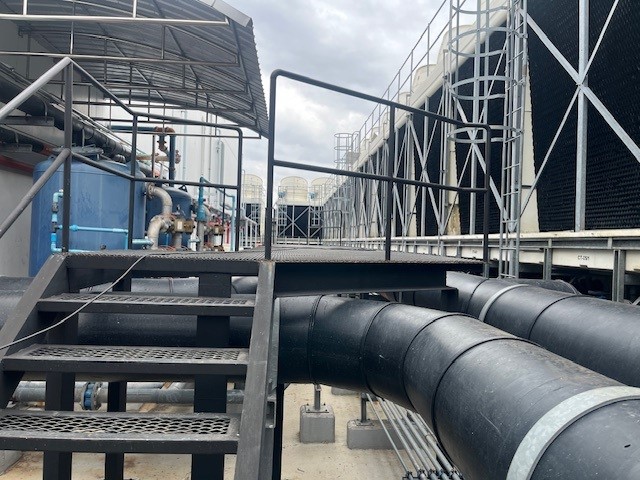
WELL Certification and Cooling Towers: Meeting the Legionella Precondition and LEED Water Goals Together
More building owners in Thailand and Southeast Asia now aim for two certificates at once: LEED for environmental performance and WELL for the health of the people inside. Both standards look closely at one piece of equipment that most occupants never see: the cooling tower on the roof.
The two standards ask different questions. WELL asks whether the cooling tower is a health risk. LEED asks how much water it wastes. The good news is that one treatment strategy can answer both.
What WELL v2 asks of your cooling tower
The WELL Building Standard, run by the International WELL Building Institute (IWBI), is built on preconditions (mandatory) and optimizations (optional points). In WELL v2, Legionella control moved up to a precondition. A building that cannot show it is managing Legionella cannot be certified at any level.
The requirement sits in feature W03, Basic Water Management. It asks for a written Legionella management plan covering every place in the building where water is recirculated and sprayed into the air: hot water systems, decorative fountains and, above all, cooling towers. Where the building operates its own cooling towers, the plan must also include a Legionella sampling schedule and the results.
WELL does not tell you which treatment to use. It is performance-based: you choose the method, then prove it works through monitoring, records and test results.
What LEED asks of your cooling tower
LEED, from the U.S. Green Building Council, rewards cooling towers that use less water. The key measure is cycles of concentration: how many times the water is reused before it is bled off as blowdown. More cycles means less make-up water and less discharge.
In LEED v5, cooling tower points sit within the Enhanced Water Efficiency credit. Earlier versions (v4 and v4.1) had a separate Cooling Tower Water Use credit. Either way, the project must show it can run at high cycles without exceeding safe limits for scale-forming minerals. For a full explanation of LEED levels and credits, see our article LEED Certification Explained.
WELL and LEED side by side
| WELL v2 | LEED | |
|---|---|---|
| Main concern | Occupant health (Legionella) | Water efficiency |
| Status | Mandatory precondition (W03) | Optional points |
| What you must show | A Legionella management plan, sampling schedule and records | Make-up water analysis and achievable cycles of concentration |
| Biggest obstacle | Biofilm and deposits where bacteria shelter | Scale that limits how high cycles can go |
Why the two goals can pull against each other
With conventional chemical treatment, the two standards can work against each other. Raising cycles for LEED concentrates minerals in the water, which raises the scale risk. The usual answer is more scale inhibitor. Scale and sludge then give biofilm more surfaces to grow on, which is exactly what a WELL Legionella plan is trying to prevent. The usual answer to that is more biocide.
The result is a building that earns its certificates while storing and dosing more hazardous chemicals, and discharging more of them to drain. That sits awkwardly with the health and sustainability goals that led the owner to WELL and LEED in the first place. (Read more on the risks in Legionella in Cooling Towers: Risks, Warning Signs and How to Prevent It.)
One strategy for both: clean surfaces, without chemicals
The link between the two standards is the condition of the surfaces inside the system. Clean condenser tubes, fill and basins carry no scale for minerals to build on and no deposits for Legionella to hide in.
Elgressy EST (Electrolysis Scale Treatment) works on exactly this point. It uses electrolysis to pull scale-forming minerals out of the circulating water inside the EST reactor, where they are collected and flushed away, instead of letting them settle in the plant. Continuous treatment also controls corrosion and biofouling, without biocides or inhibitors.
- For WELL: continuous control of scale and biofilm, plus the commissioning handover report and operator training that ALA provides on every project, give the Legionella management plan a clear treatment method and records to point to.
- For LEED: because scale is removed continuously, the tower can be run at higher cycles of concentration, cutting make-up water and blowdown.
- For both: no treatment chemicals to store, handle or discharge, and a guaranteed corrosion rate of max. 2 mpy that protects the equipment at the chosen cycles.
EST does not replace good practice. Monitoring and Legionella sampling, as WELL requires, still belong in the plan. And no product is ever “WELL certified” or “LEED certified”: these standards certify buildings. What EST does is make the cooling tower parts of both standards easier to meet.
A checklist for owners and consultants
If your project is aiming for WELL, LEED or both, these questions are worth settling early in design:
- Is every cooling tower, evaporative condenser and decorative water feature included in the Legionella management plan?
- Who has operational control of the cooling towers, and is the sampling schedule in place?
- Has a make-up water analysis been done to calculate the maximum achievable cycles?
- What limits those cycles today: hardness, silica, or the treatment program?
- How much treatment chemical will be stored on site and discharged each year?
- Will the treatment method produce the records the WELL and LEED reviewers need?
Talk to us early in your project
ALA has been the exclusive Elgressy distributor in Southeast Asia since 2010, and the Elgressy EST-N systems have been examined and approved by the IFC (International Finance Corporation). We can provide a free water analysis and cycles calculation for your WELL or LEED consultant.
See how EST fits WELL and LEED projects on our Cooling Tower Water Treatment for WELL & LEED Buildings page, or contact us at +66 64 284 6598 (English) or +66 63 957 8383 (Thai).


