Electrocoagulation and Electro-Oxidation: Chemical-Free Water and Wastewater Treatment
Conventional wastewater treatment relies heavily on chemicals: coagulants, flocculants, pH adjusters, oxidants and biocides. They cost money every month, need storage and handling, and add to the sludge you have to dispose of. Electrochemical treatment replaces most of those chemicals with electricity.
This guide explains the two key electrochemical technologies, electrocoagulation (EC) and electro-oxidation (EO), how they work, what they remove, and where they make sense for industrial plants in Southeast Asia.
Key Takeaways
- Electrocoagulation uses metal electrodes and direct current to release coagulating ions into the water, so suspended solids, oils, colour and heavy metals clump together and separate.
- Electro-oxidation uses non-dissolving anodes to generate powerful oxidants directly in the water, destroying organic pollutants, ammonia and pathogens.
- Both are chemical-free or nearly so: no polymers, coagulants or biocides to buy, store or dose.
- Typical benefits: lower operating cost, less sludge, compact footprint and full automation.
What Is Electrocoagulation?
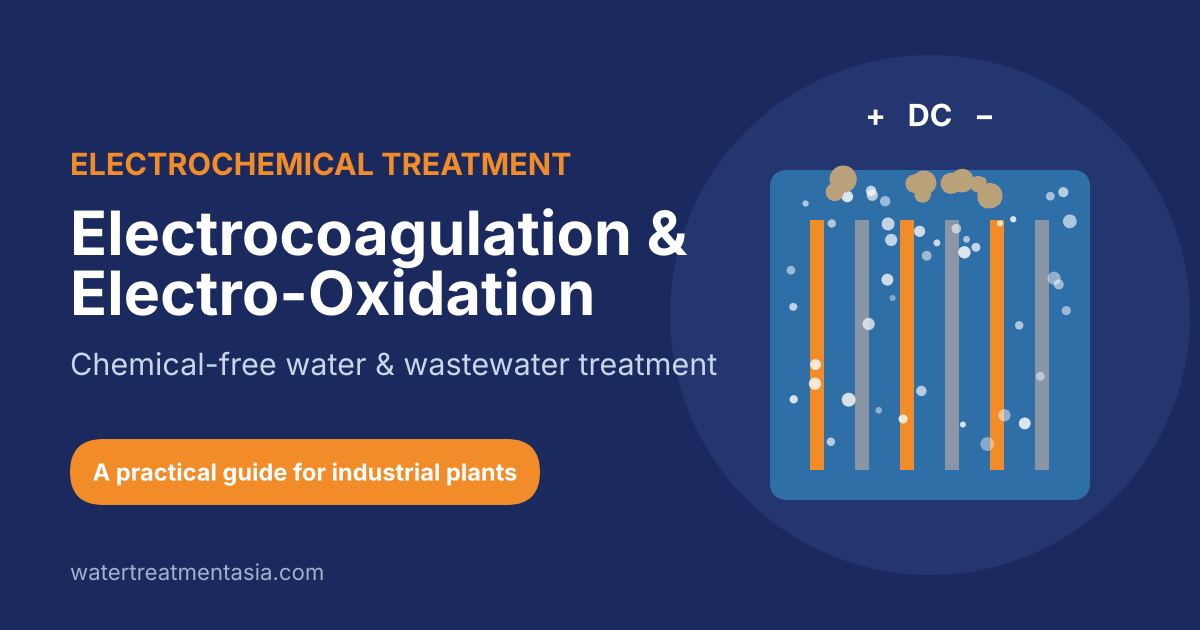
Electrocoagulation (EC) is an electrochemical process that destabilises and removes contaminants by passing direct current (DC) through metal electrodes, usually iron or aluminium, immersed in the water.
How Electrocoagulation Works
- Electric current: DC flows between the anodes and cathodes in the reactor.
- Metal ions released: the sacrificial anode slowly dissolves, releasing iron or aluminium ions into the water.
- Charge neutralisation: these ions neutralise the electrical charges that keep fine particles, colloids and emulsified oils suspended.
- Floc formation: the ions form metal hydroxides that trap dirt, oils and heavy metals in larger flocs.
- Separation: hydrogen bubbles from the cathode float some flocs to the surface, while heavier sludge settles. Both are easily removed by flotation, settling or filtration.

Because the coagulant is generated in place, there is no need to dose polymers or coagulants such as PAC or PAM, and the sludge produced is usually more compact and easier to dewater than chemical sludge.
What Affects Electrocoagulation Performance?
- Electrode material: iron and aluminium are standard; the choice depends on the contaminants to be removed.
- Electrode configuration: monopolar (parallel) arrangements suit lower-conductivity water, while bipolar (series) arrangements suit higher-conductivity water.
- Current density and treatment time: more current and longer contact time increase removal, but also energy and electrode consumption. The optimum is found in testing.
- pH and conductivity: both influence floc formation and power demand.
What Is Electro-Oxidation?
Electro-oxidation (EO), also called anodic oxidation, is an advanced oxidation process. Instead of dissolving, the anodes are made of stable, specially coated materials. When current flows, they generate highly reactive species directly in the water, including hydroxyl radicals, ozone and, where chlorides are present, active chlorine.
- Direct oxidation: hydroxyl radicals at the anode surface attack organic molecules, breaking them down step by step, ultimately to carbon dioxide and water.
- Mediated oxidation: oxidants such as active chlorine spread through the water and continue treatment away from the electrode, which also disinfects.
Electro-oxidation is especially effective on pollutants that biological treatment cannot handle: dyes, pharmaceuticals, pesticides, phenols, ammonia and other persistent compounds.
Electrocoagulation vs. Electro-Oxidation
| Electrocoagulation (EC) | Electro-oxidation (EO) | |
|---|---|---|
| Electrodes | Sacrificial (iron or aluminium), replaced periodically | Stable, non-dissolving coated anodes |
| Main mechanism | Coagulation, flocculation and flotation | Oxidation by radicals, ozone and active chlorine |
| Best at removing | Suspended solids, oils and grease, colour, heavy metals, phosphates, silica | Dissolved organics (COD), ammonia, dyes, persistent compounds, pathogens |
| By-product | Compact metal-hydroxide sludge | Little or no sludge |
| Main operating cost | Electricity and electrode replacement | Electricity |
The two processes work well together: EC removes the solids, oils and metals first, then EO polishes the remaining dissolved organics and disinfects. Combining them often achieves treatment standards at a lower total energy cost than either process alone.

Typical Applications
Electrochemical treatment has been tested and applied across a wide range of water and wastewater streams, including:
- Textile and dye-house wastewater, where EC is one of the most effective colour-removal methods
- Oily wastewater, cutting fluids and emulsions
- Food, beverage, vegetable-oil and restaurant wastewater
- Petroleum refinery wastewater and oilfield produced water
- Metal finishing and electroplating effluent containing heavy metals
- Laundry, municipal and paper-industry wastewater
- Surface and groundwater containing arsenic, silica, hardness or natural organic matter
- Cooling water, where Elgressy’s EST systems use electrolysis to prevent scale, biofouling and corrosion without chemical inhibitors

Benefits for Industrial Plants
- Chemical-free: no coagulants, polymers or biocides to purchase, store or handle.
- Less sludge: lower sludge volumes than conventional chemical coagulation.
- Low operating cost: costs are mainly electricity and, for EC, electrode replacement.
- Compact and simple: no moving parts in the reactor, a small footprint and easy retrofitting into existing plants.
- Automated: minimal operator intervention once commissioned.
- Lower carbon footprint: fewer chemical deliveries and less sludge transport and disposal.
Start with a Treatability Test
Every wastewater is different. The most reliable way to size an electrochemical system and confirm removal rates, energy use and operating cost is a treatability test on your actual water, followed where needed by an on-site pilot. Elgressy supplies laboratory and pilot test equipment for exactly this purpose.
Related Reading
- Calcium Carbonate (CaCO3) Scale in Heat Exchangers
- Legionella in Cooling Towers: Risks, Warning Signs and How to Prevent It
- Carbon Steel in Cooling Systems: Types, Properties and Corrosion Control
Talk to Us About Your Wastewater
Water Treatment Asia is the exclusive distributor of Elgressy electrochemical water treatment systems in Southeast Asia, including electrocoagulation (EEC), electro-oxidation (EEO) and Electrolysis Scale Treatment (EST). Contact our team to discuss your application and arrange a treatability test.


Leave A Comment