
Legionella is the bacterium behind Legionnaires’ disease, a severe and sometimes fatal pneumonia. People catch it by breathing in fine droplets of contaminated water from showers, taps and spray outlets. The elderly, young children, smokers and patients with weakened immune systems are most at risk, which is why hospitals and hotels carry the biggest responsibility.
Most people link Legionella to cooling towers. But the hot and cold water systems inside a building, the water that reaches every shower and tap, are just as important. This article explains where Legionella grows in hot and cold water, and how the Elgressy LPB controls it without dosing chemicals.

Where Legionella grows in hot and cold water systems
Legionella multiplies fastest between about 20 °C and 45 °C. Below 20 °C it survives but does not grow. Above 50 °C it starts to die, at 60 °C it is killed within minutes, and above 70 °C it dies almost at once.

Hot water systems. Sediment and scale settle at the bottom of hot water tanks and calorifiers, where the water is cooler and still. That sludge is a perfect breeding ground. Long pipe runs, mixing valves and the circulation return often run lukewarm, well inside the growth zone.
Cold water systems. In a warm climate like Thailand’s, roof tanks, storage tanks and cold-water pipes easily warm up into the growth zone, especially where water stands still in dead legs or in rooms that are rarely used.
Chemical dosing and periodic “heat shocks” are the usual answers. Chemicals have to be bought, stored, handled and dosed for as long as the building runs, and they can attack pipes and fittings. A one-off heat shock kills bacteria for a while, but if the sediment stays, they come back.
How the Elgressy LPB controls Legionella

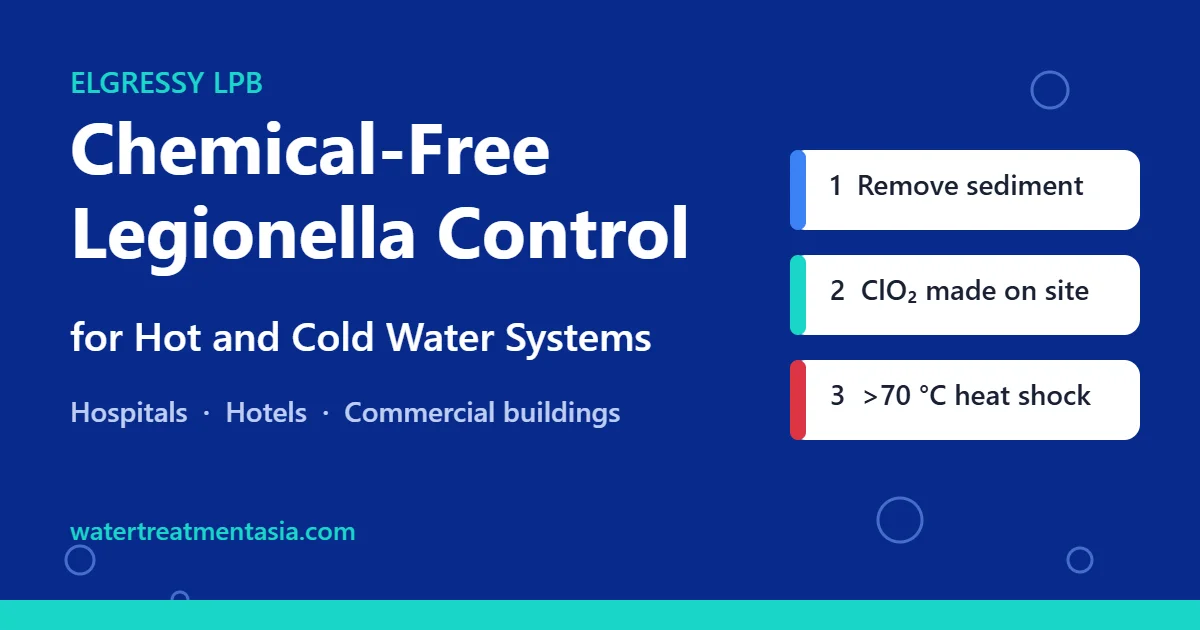
The LPB is an automatic system from Elgressy Engineering Services that disinfects hot and cold water systems. It attacks Legionella in three stages.

1. Remove the breeding ground
The LPB takes water from the drain of the hot water tank. Turbulence at the water entry point keeps sediment and scale from settling at the bottom of the tank, so the bacteria lose their growth medium. The LPB also precipitates part of the scale in its own reaction tank, where an automatic scraper and drain valve remove it.
2. Electrochemical disinfection with chlorine dioxide
Inside the reaction tank, patented titanium and nickel-oxide anodes produce a small, controlled amount of chlorine dioxide (ClO2) when direct current passes through them. The disinfectant is made on site by electrolysis, so there are no drums of biocide to buy, store or handle. The anodes do not corrode and last for several years.
The system controls itself. A chlorine dioxide sensor on the hot water circulation return measures the level, and the controller adjusts the current to hold the programmed value. Elgressy’s design levels are about 0.8 ppm ClO2 leaving the reaction tank and above 0.2 ppm in the main return line.
3. High-temperature treatment
Treated water then passes through the heat exchangers, where temperatures above 70 °C kill any remaining bacteria. In cold-water systems, where the water cannot be heated, the on-site chlorine dioxide carries the disinfection.

Proven in a hospital: Assaf Harofeh Medical Center
Elgressy tested the LPB for a full year, from May 2003 to May 2004, on the hot water system of the Assaf Harofeh Medical Center in Israel. The building had five hot water tanks. The LPB was connected to tank 4, and tank 5 served as the control.

- Legionella pneumophila (serogroup 3) was present at the LPB inlet in July and August 2003.
- No Legionella was found at the LPB outlet during the whole year.
- The LPB caused no change in the chemical composition of the water.
The LPB is patented in Israel and has been tested and approved by the Israeli and Spanish Ministries of Health.
Why hospitals, hotels and buildings choose the LPB
- Removes the health risk: continuous disinfection plus heat, not a one-off shock.
- No chemicals to buy or store: the disinfectant is made on site.
- Prevents regrowth: less sediment and scale means less breeding ground.
- Protects the system: non-corrosive, so pipes, tanks and fittings last longer.
- Low running costs: automatic control, low maintenance and long anode life.
For buildings aiming for WELL or LEED certification, controlling Legionella is part of the water requirements. Read more in WELL certification and cooling towers.
Protect your hot and cold water system
ALA (Aerial Lift Asia Co., Ltd.) has been the exclusive Elgressy distributor in Southeast Asia since 2010. Send us a short description of your hot and cold water system, the number of tanks and their volume, and any recent Legionella test results, and we will propose the right LPB set-up for your hospital, hotel or building. Contact Water Treatment Asia, or call 064 284 6598 (English) or 063 957 8383 (Thai).
Read more: LPB overview, Bacteria eradication, Legionella in cooling towers and What is chemical-free water treatment?
Sources
- Elgressy Engineering Services, LPB brochure (2026) and LPB product information
- Elgressy Engineering Services, LPB case study, Assaf Harofeh Medical Center, May 2003 – May 2004


Leave A Comment